Kafka vs RabbitMQ: Choosing the Right Messaging Backbone
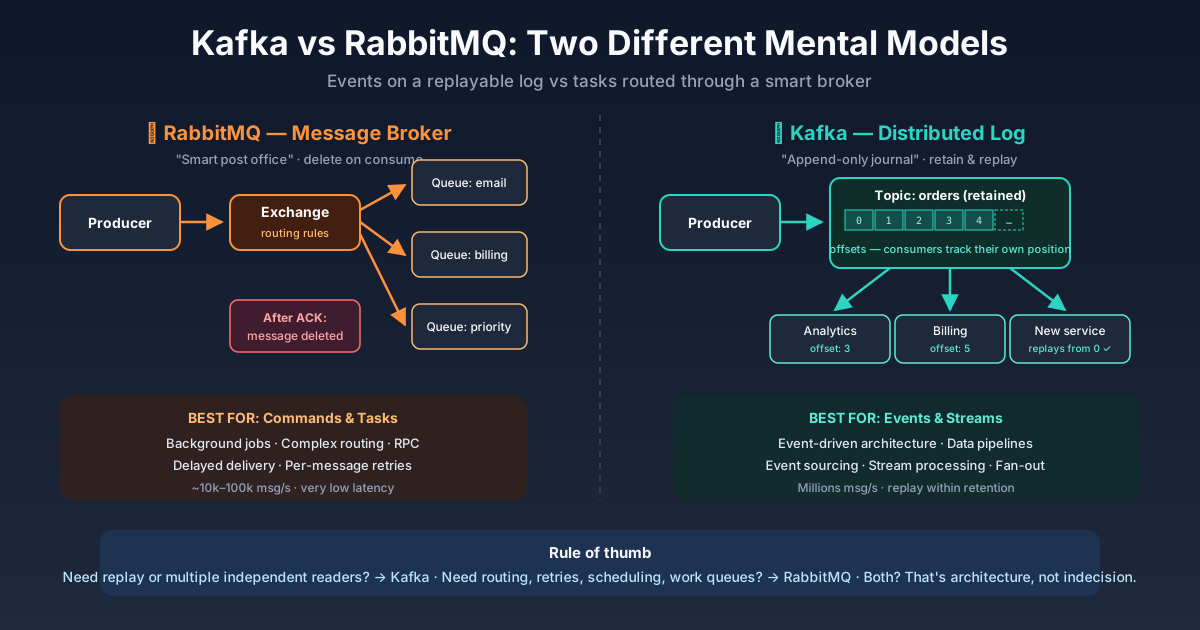
Sooner or later, every growing system needs services to talk to each other asynchronously. And when that moment arrives, the same debate starts in the team channel: Kafka or RabbitMQ?
The honest answer is that they're not really competitors — they were built to solve different problems, and they solve them well. In this post I'll break down how each one works, where they shine, and how to choose without regret.
Two Different Mental Models
The most important thing to understand is that Kafka and RabbitMQ are built on fundamentally different ideas.
RabbitMQ is a message broker. Think of it as a smart post office. Producers hand it messages, it routes them through exchanges to queues based on rules you define, and consumers take messages off the queues. Once a message is consumed and acknowledged, it's gone. The broker is smart, the consumers are simple.
Kafka is a distributed commit log. Think of it as an append-only journal. Producers append events to topics (split into partitions), and those events stay there for a configured retention period — hours, days, or forever. Consumers read the log at their own pace, tracking their own position (offset). The broker is simple, the consumers are smart.
This one difference — delete on consume vs retain and replay — explains almost everything else about when to use each.
How RabbitMQ Works
RabbitMQ implements AMQP (Advanced Message Queuing Protocol) and revolves around three concepts:
- Exchanges receive messages from producers and route them. Types include direct (exact routing key match), topic (pattern matching like
orders.*.eu), fanout (broadcast to all bound queues), and headers. - Queues buffer messages until a consumer processes them.
- Bindings connect exchanges to queues with routing rules.
Producer → Exchange → (bindings/routing) → Queue(s) → Consumer
Strengths that follow from this design:
- Flexible, fine-grained routing. Complex delivery rules live in the broker, not your code.
- Per-message acknowledgment and requeue. Failed messages can be retried or dead-lettered individually.
- Priority queues, TTLs, delayed delivery — rich messaging semantics out of the box.
- Low latency for individual messages — often sub-millisecond.
- Mature protocol support — AMQP, MQTT, STOMP — great for heterogeneous environments and IoT.
How Kafka Works
Kafka organizes events into topics, and each topic into partitions — ordered, immutable sequences of records.
Producer → Topic (partition 0, 1, 2...) → Consumer Group(s)
- Records with the same key always land in the same partition, guaranteeing order per key (e.g., all events for
user_8842are ordered). - Consumer groups divide partitions among their members for parallel processing; each group maintains its own offsets, so multiple independent applications can read the same stream.
- Retention is time- or size-based, not consumption-based. Events remain available for replay.
Strengths that follow from this design:
- Massive throughput. Sequential disk I/O and batching let a modest cluster push millions of messages per second.
- Replayability. New services can bootstrap from history; bugs can be fixed by reprocessing.
- Multiple independent consumers of the same data without duplicating it.
- Stream processing ecosystem — Kafka Streams, ksqlDB, and first-class integration with Flink and Spark.
- Event sourcing friendly. The log is the source of truth.
Head-to-Head Comparison
| Dimension | RabbitMQ | Kafka |
|---|---|---|
| Core model | Message broker (delete on ack) | Distributed log (retain & replay) |
| Best throughput profile | Tens of thousands msg/s | Millions msg/s |
| Latency | Very low per message | Low, optimized for batches |
| Message replay | No (gone after ack) | Yes, within retention |
| Routing logic | Rich (exchanges, patterns, priorities) | Simple (topic + partition key) |
| Ordering | Per queue | Per partition (per key) |
| Consumer model | Broker pushes, tracks delivery | Consumers pull, track offsets |
| Delayed / scheduled messages | Built-in (plugin) | Not native |
| Operational complexity | Lower for small setups | Higher (cluster, partitions) — reduced with KRaft & managed services |
| Typical role | Task queues, RPC, command distribution | Event streaming, pipelines, event sourcing |
When to Choose RabbitMQ
Choose RabbitMQ when your messages are commands or tasks — things that should be processed once and disappear:
- Background job processing — send emails, generate PDFs, resize images.
- Complex routing requirements — "send EU orders to this service, priority customers to that one."
- Request/reply (RPC) patterns between services.
- Delayed or scheduled delivery — retry this payment in 15 minutes.
- Lower-volume systems where operational simplicity matters — a single RabbitMQ node is trivial to run.
When to Choose Kafka
Choose Kafka when your messages are events or facts — records of things that happened, which multiple systems may care about now or later:
- Event-driven architectures —
order_placedis consumed by billing, inventory, analytics, and notifications independently. - High-volume data pipelines — clickstreams, IoT telemetry, log aggregation (yes, this connects to my previous post — Kafka is a common transport for centralized logging).
- Event sourcing and audit trails — the retained log is your history.
- Stream processing — real-time aggregation, enrichment, fraud detection.
- Fan-out to many consumers at scale without duplicating messages.
Can You Use Both?
Absolutely — and many mature architectures do. A common pattern:
- Kafka as the event backbone: every significant business event flows through Kafka topics, feeding analytics, search indexing, and downstream services.
- RabbitMQ for task distribution: when a Kafka consumer decides work must happen (send an email, call a third-party API with retries), it enqueues a task in RabbitMQ where per-message retry and dead-lettering semantics are stronger.
Events on Kafka, commands on RabbitMQ — a simple rule that holds up surprisingly well.
Common Mistakes to Avoid
- Using Kafka as a job queue. Individual message retry/skip is awkward on a log; a poison message can block a partition.
- Using RabbitMQ for replayable event streams. Once acked, messages are gone — no bootstrapping new consumers from history.
- Ignoring partition key design in Kafka. Poor keys cause hot partitions and broken ordering assumptions.
- Unbounded queues in RabbitMQ. If consumers fall behind, memory pressure degrades the whole broker — set queue limits and monitor depth.
- Choosing by hype instead of fit. Kafka on your CV is nice; Kafka for a 50-messages-per-minute workload is an operational tax.
The Decision in One Paragraph
Ask one question: do I need to replay these messages, or deliver them to multiple independent readers? If yes, you're describing an event stream — use Kafka. If instead you need rich routing, per-message retries, scheduling, or classic work queues, you're describing task distribution — use RabbitMQ. And if your system genuinely has both kinds of traffic, using both isn't indecision; it's architecture.
This is the second post in my series on backend infrastructure. If you missed it, check out my first post on enhancing observability through better logging — messaging systems and observability go hand in hand.